Uses and Gratification of the media towards the audience
A famous individual who went by the name Laswell suggested that media texts do the following for an audience:
surveillance
correlation
entertainment
cultural transmission
In 1974 there were two researchers named Blumer and Katz came up with something which stated that the audience may chose and use a text for some of these purposes:
Diversion – escape from everyday problems and routine.
Personal Relationships – using the media for emotional and other interaction
Personal Identity – finding yourself reflected in texts, learning behaviour and values from texts
Surveillance – Information which could be useful for living
Reception Theory
This theory was founded from work that Stuart Hall had done, this theory states that the text is encoded by the producer and that it is decoded by the reader and that there may be major differences of the code between the two because there are very different mindsets behind who is reading them. If the producers use codes and conventions which are well known by the audience then they can put the audience in a specific position that they will agree with the meaning of the code according to the producer.
A media text has no meaning until it is read or decoded by an audience. Over the course of the past centuries, people who analyze media have developed many theories from the information that they perceived in media. In this post we will analyze some of the theories which have been developed.
Paul Lazarsfeld, Bernard Berelson, and Hazel Gaudet came up with a theory after analyzing the audience of a 1940 election and they came up with an idea that information does not flow directly from the text into the minds of its unmediated but instead is filtered through opinion leaders which read their opinion to the audience and may be able to influence them with their ideas. After this the audience then mediates the information that they have heard and ideas which they have heard from the media. Now this is called the two step flow theory because the audience is being influenced by not one source only but now two.
Hypodermic Needle model
This was one of the first theories created and this theory tries to explain how mass audiences may react to mass media. It suggests that audience passively receive the information which is transmitted from a media text. Now this doesn’t take any attempt from them to process or challenge the data that they are shown. This theory was done when mass media had just been introduced, so people weren’t really used to mass media. Basically this theory explains how information from the media passes into the audience mass consciousness unmediated. It also explains that the audience is manipulated by the media to make our thought process change in order to their favor, and that we are passive and heterogeneous.
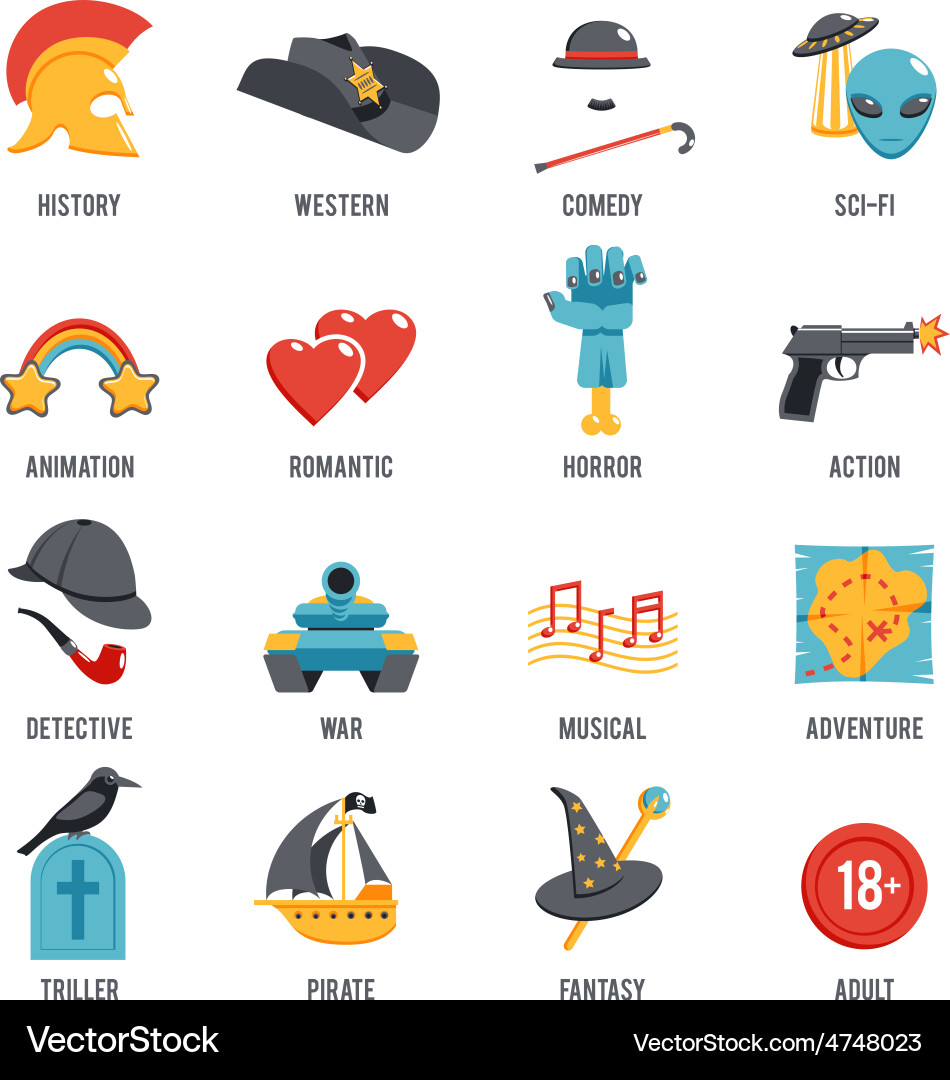
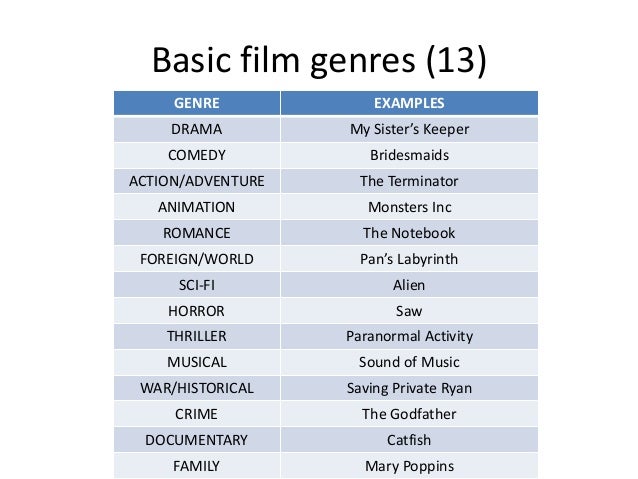
Film genres need to be fluid, these need to consists of shifting evolving sets of paradigms. If this weren’t the case then film would be making the same movies part of the same genre groups and the stories wouldn’t be changing and it’d become very bland. That’s why over the centuries there has been the creation of “Sub Genres”. These sub genres are often created by a mash up of putting things together and putting conflicting genres that may not fit with each other. An example of some of the hybrid mixes we see with the horror genre are as follows:
Horror Romance
Horror War
Horror Historical Drama
Horror RomCom
Here are some mashups in the comedy genre:
Black-Comedy
Horror-Comedy
Drama-comedy
Parody/Spoof
Romantic-Comedy
Subgenres
Since there is only a specific amount of genres and that you can only make a specific amount of entertaining movies in a specific genre that keeps the audience entertained before becoming bored came the creation of sub genres, which is more genres that are under one specific main genre. Sub genres can be created in response to movies that are able to push genre paradigms in a successful way or external socio historic factors, and cross traditional genre boundaries.
Some examples of sub genres that exist within some main genres are:
This is an important topic for critics, film makers, audiences, and media theorists. It is very important the way that people chose to watch movies, this is important for the initial marketing of a movie. It as well has academic and as well practical applications. Genres can be as much about the differences between two just as the similarities.
A Functional Approach
In this type of approach the genres in film are perceived as collective expressions in temporary life that strike a particular resonant cord in the audience. Some repetitions that are seen in film genres as well considered repetition of social questions which need to be answered by the audience. They are known as:
What is frightening, or what possibilities do we fear? (horror films)
What is criminal, or what are the boundaries of social morality that we must not cross? (gangster films)
What is morality? (melodramas)
What is acceptance and belonging? (romantic comedies)
What is alien? (science fiction)
What is the future? (science fiction again)
A combination of these two approaches is sometimes considered one of the most successful ones. These questions have as well been repeated throughout the many generations of film and have been tweaked here and there since times have been changing.
Descriptive Approach
The most straight forward way in which analyzing films is the descriptive way. This has to do with the specific categories a film fits into. When analyzing a film you use a thing which is known as paradigm shifts and as well the analyzing of costume, location, character archetypes, shot transitions, or plot content that are seen throughout the film. A thing that is known is that a film can belong to many different categories even though it is said to be in one type of genre.
pre-figuring of events that have not yet taken place
In media narrative is the coherence/organization which are given to a series of facts. Story in media is the irreducible substance of a story, Narrative is the way the story is related. Successful stories require actions which change the lives of the characters in the story, also contain some sort of resolution, and the change must be registered. There is also narratives in stories advertisements and documentaries which have to be interpreted. In narrative there are four conventions which are:
Genre
Character
Form
Time
Now there is another theory for narrative which is known as the Todorov narrative, in which it basically says that narrative is equilibrium, disequilibrium, and new equilibrium. When it comes to POV’s the narrator will always:
reveal the events which make up the story
mediate those events for the audience
evaluate those events for the audience
In media narrative is the coherence/organization which are given to a series of facts. Story in media is the irreducible substance of a story, Narrative is the way the story is related. Successful stories require actions which change the lives of the characters in the story, also contain some sort of resolution, and the change must be registered. There is also narratives in stories advertisements and documentaries which have to be interpreted. In narrative there are four conventions which are:
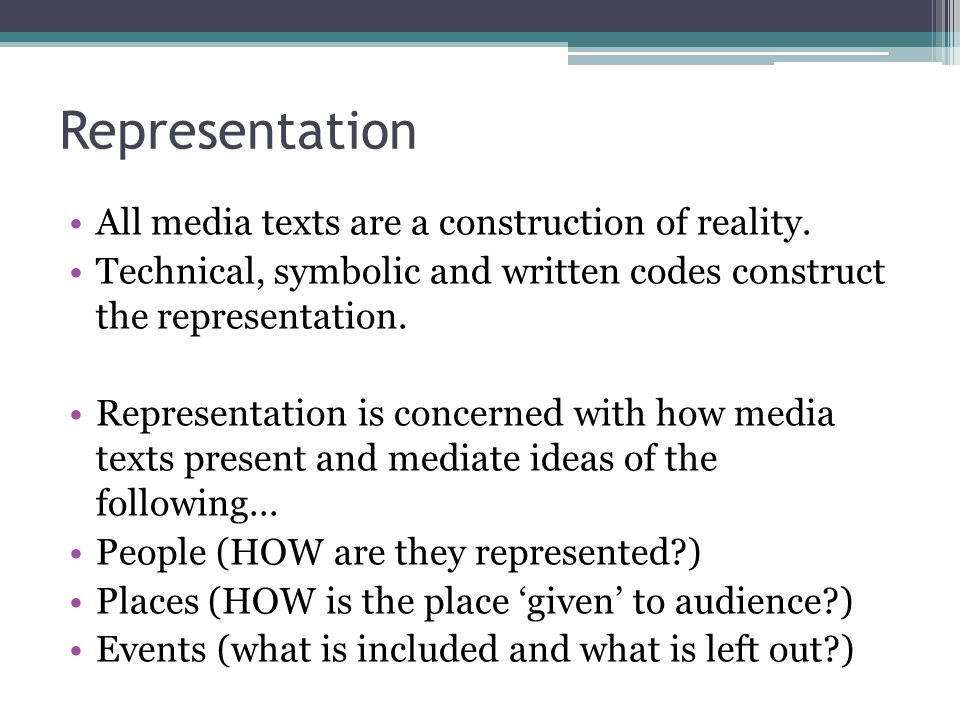
The other day in my AS Media Studies class we discussed the different ways of representation in media. The main representations we discussed were Gender, Age, Race, and Disability. I know that there is many more representation is media but out of all the choices you have these are considered some of the most important ones. In this post I will give a description of each of these four things we discussed.
Age
After gender age is considered the most stereotypical in the media industry, there is many biased judgments when it comes to the different age groups that exist. Age like race is something that can’t be changed but many people will try anything possible in order for people not to know their true age so they won’t get stereotyped. People will dye their hair, get plastic surgery, dress differently and do many other things to hide their age.
Young people are usually shown as:
Immature,
stupid,
greedy,
lazy,
selfish,
unfit,
obese,
violent,
callous,
gullible,
unreliable,
careless,
self-entitled,
never going to achieve anything
Old people are usually shown as:
Grumpy,
out-dated,
slow,
weak,
whining,
unable to use technology,
unhealthy,
miserly,
hard-of-hearing,
ugly,
never go anywhere
Gender
Gender is considered to be one of the basic things when sorting out human beings and is considered one of the key discussions when it comes discussing representation in media. Now in media they can be stereotypical and usually show men as a masculine and strong figure and women are usually shown as being feminine and delicate.
Things that can usually found in men/masculine figure
Tough
Hard
Sweaty
Male characters are usually shown as isolated and needing help and relying on others for that. Men are finding it more difficult to live up to their media representations then women because of the different things they are expected to do such as being masculine. Teenage anorexia has increased over the past years and so has school shootings because of the body expectations people are supposed to have. Awareness has been growing over the years of these unrealistic targets.
Things that can usually be found in a women/feminine figure
Fragile
Soft
Fragrant
Women in media are usually shown as being part of the context and being a key role of the team such as thinking and helping them with different issues. The representations of women are usually very stereotypical, in societal expectations and as well characters that aren’t molded into these general stereotypes are usually seen as a dangerous and deviant character to the audience. Discussion of women in media usually revolve basically around physical beauty and there is a lacking of powerful female role models in the media industry.
Disability
In media you usually have three stereotypical representations of people with disabilities:
The villain
The victim
The hero
People with disabilities are usually seen as objects of pity and are shown as having the same characteristics and tendencies no matter what disability they may have. Another thing is that in media the full range of disabilities isn’t shown to the audience.
The most stereotypical thing for people with disabilities to be categorized in is the victim category. They are usually shown as an object of sympathy and not having the power to do anything. There is also situations in which it shows them as being victims for a comedy purpose, to make the audience laugh at them.
The next category is them being shown as being hero’s. They are usually shown as able to overcome their disability and then being able to help someone in need. Usually in video games there is lots of stereotyping, people are usually shown as having supernatural powers which they can use towards their advantage to help people. In media as well people who have disabilities in films are always played by actors who don’t have any real disabilities. It is also usually portrayed that they need to overcome their problem to become “normal”
The final category in which they are stereotyped is villains. In films villains are usually shown as having no hands, eyes, their face is messed up and so many other things. Mental illness is also something which is portrayed in villains. A perfect example is the joker in the film “Joker”, which the main character is shown as being a sociopath who gets into dark crimes. An example of disabled people who are shown as villains are all the pirates in “Pirates Of The Caribbean”.
Race
Representation in media of race consist of the same stereotypes that are used for gender. Stereotyping of race in media is seen as more harmful then stereotyping gender. Racial stereotypes are usually based on myths that have been passed down the ages. The need for a more accurate depictions of the different races in media has been a hot topic in the political agenda, but this will most likely take a long time to achieve this.
This year in AS Media Studies has gone by so fast I honestly can’t believe it, in two months my final project is due which will be a film opening trailer. As I’ve mentioned before in many of my other posts the genre which we will be doing for this trailer will be Horror. Over the past month or so I’ve been doing research on all the codes and conventions which are usually seen in Horror movies. I think I’ve finally been able to gather enough evidence to get a 360 of how Horror movies are and how I can do mine. My partner and I agreed that we should start to get the ball rolling and to get the basic steps done with. Currently me and my partner haven’t done much but in this post I will discuss some of the ideas that me and my partner have.
Some Ideas
One thing that me and my partner immediately knew was what our roles were going to be in the movie. We both agreed that my partner would be the main actor in the film, and that I would be in charge of all the filming and camera work. I know there’s many more roles but for now that’s what we’ve figured out in the acting area. I chose my partner to be the main actor because I find that he is very passionate when to comes to film and also acting. Location wise I’m not sure where we should film, I’m trying to find a location that is dark, isolated, gives an eerie feeling, etc.
Some places I was thinking of was a forest, maybe a big house that’s secluded somewhere along those lines. Script wise me and my partner have not started to write our script yet due to the fact that we still haven’t really made a story line because we are still trying to mold our vision of a horror movie. Over the next couple of weeks my partner and I will continue to build up everything for this movie, but as mentioned in the beginning of this post we’re still in the starting process and in the building blocks. It just makes me very excited that we’re finally starting our final project and that I can have all the knowledge which I learned from research and my As Media Studies.
Lee was born in Atlanta, Georgia, the son of Jacqueline Carroll (née Shelton), a teacher of arts and black literature, and William James Edward Lee III, a jazz musician and composer.Lee has three younger siblings, Joie, David, and Cinqué, each of whom has worked in many different positions in Lee’s films. Director Malcolm D. Lee is his cousin. When he was a child, the family moved from Atlanta to Brooklyn, New York. His mother nicknamed him “Spike” during his childhood. He attended John Dewey High School in Brooklyn’s Gravesend neighborhood. Lee enrolled in Morehouse College, a historically black college, where he made his first student film, Last Hustle in Brooklyn. He took film courses at Clark Atlanta University and graduated with a B.A. in mass communication from Morehouse. He did graduate work at New York University’s Tisch School of the Arts, where he earned a Master of Fine Arts in film and television.
Notable works
“Do the right thing” 1989
“He Got Game” 1998
“Invisible Man” 2006
“When We Were Kings” 1996
“BlacKkKlansman” 2018
Awards and Achievements
In 1983, Lee won the Student Academy Award for his film Joe’s Bed-Stuy Barbershop: We Cut Heads. He won awards at the Black Reel Awards for Love and Basketball, the Black Movie Awards for Inside Man, and the Berlin International Film Festival for Get on the Bus. He won BAFTA Award for Best Adapted Screenplay for BlacKkKlansman. Lee was nominated for Academy Awards for Best Original Screenplay for Do the Right Thing and Best Documentary for 4 Little Girls, but did not win either award. In November 2015, he was given the Academy Honorary Award for his contributions to filmmaking.In 2019, he received his first Best Picture and Best Director nominations and went on to win Best Adapted Screenplay for BlacKkKlansman, his first Academy Award. Two of his films have competed for the Palme d’Or award at the Cannes Film Festival, and of the two, BlacKkKlansman won the Grand Prix in 2018. In 2019, Lee’s film She’s Gotta Have It was selected by the Library of Congress for preservation in the National Film Registry for being “culturally, historically, or aesthetically significant”.
Personal Style
Lee’s films have examined race relations, colorism in the black community, the role of media in contemporary life, urban crime and poverty, and other political issues. His films are also noted for their unique stylistic elements, including the use of dolly shots to portray the characters “floating” through their surroundings, which he has had his cinematographers repeatedly use in his filmography.[citation needed] Lee’s films are typically referred to as “Spike Lee Joints”. The closing credits always end with the phrases “By Any Means Necessary”, “Ya Dig”, and “Sho Nuff”. His 2013 film, Oldboy, used the traditional “A Spike Lee Film” credit after producers had it re-edited.
Accompanied by her husband, son and daughter, Adelaide Wilson returns to the beachfront home where she grew up as a child. Haunted by a traumatic experience from the past, Adelaide grows increasingly concerned that something bad is going to happen. Her worst fears soon become a reality when four masked strangers descend upon the house, forcing the Wilsons into a fight for survival. When the masks come off, the family is horrified to learn that each attacker takes the appearance of one of them.
Film Trailer
In-depth Analysis
Peele’s opening is up there with the nightmare classics. After titles that assert there are thousands of miles of tunnels under the U.S., many of which “have no known purpose at all,” we’re in a beachside Santa Cruz amusement park in 1986, where a little girl wanders away while her father is distracted by a game of Whac-a-Mole. (What better metaphor for macho futility?) Gothic convention compels the girl to enter a fun house on the beach with a sign reading vision quest: find yourself. In the hall of mirrors, she nervously whistles “Itsy Bitsy Spider” — and then hears someone whistling it back. What appears to be her mirror image is actually … well, that’s the question. The credit sequence that follows is diabolically brilliant: The camera rests on a white rabbit, then slowly pulls back to reveal a cage and then a vast wall of cages, each with its own leporine specimen. Michael Abels’s blend of The Omen–like Latin chants and polyphonic Afro-rhythms is so infectious you don’t even realize that by tapping your feet you’re helping to conjure the devil. It possesses you, this music.
The first scenes lose the pulse, though, and the film never really recovers. In the present, the reasonably prosperous Wilson family goes to Santa Cruz for a vacation, its arrival broken by flashbacks to ’86 and the aftermath of the little girl’s trip to the fun house, when she’s mute, apparently in shock. The connection is Adelaide Wilson, who was once that little girl and is now a jittery mom played by Lupita Nyong’o. Adelaide is nervous about going back to the beach, which is easy to understand — but then why is she there in the first place? Peele’s writing is blah and perfunctory, especially when Adelaide’s husband, Gabe (Winston Duke), shows up with a powerboat he bought in a vain attempt to keep up with the Tylers (Elisabeth Moss and Tim Heidecker) and their much fancier house and athletic blonde daughters. The Wilson kids, Zora (Shahadi Wright Joseph) and Jason (Evan Alex), are more cerebral, but we don’t get to know them before the so-called “us” arrive.
Us centers on the appearance of the Wilsons’ exact doubles in the family’s driveway, which might lead you to expect semi-farcical scenes in which the identical Not-Wilsons take their look-alikes’ places or cause at least momentary (potentially deadly) confusion. But apart from Adelaide’s double, the invaders have little in the way of personality — only pairs of scissors they aim to sink into their counterparts’ throats. Peele and his cinematographer, Mike Gioulakis, show their relish for the genre in the attacks, in how the doubles seem to rise up from the ground (you don’t see how they got there) to envelop and then puncture their victims. But I almost wrote “zombie attacks”: Although it’s packed with mythically scary images, much of the movie plays like just another walking-dead splatterfest. Peele saves the big reveals for the end, when they’re effective but too late. In the ways that matter, the attackers are “them” and not “us.”
This is the sort of movie that fans will rewatch to appreciate the fillips, the purposeful echoes, the bits of foreshadowing, and the performances. Moss has little screen time, but she shows her genius as her character’s murderous double. Watch her savor the act of putting on lip gloss: Her eyes turn dreamy, and her smile spreads so wide it looks as if it will swallow her face. This is zombie Kabuki. Nyong’o hits extraordinary notes. When she’s the double, her voice is the whistle of someone whose throat has been cut, with a gap between the start of a word in the diaphragm and its finish in the head. It’s like a rush of acrid air from a tomb, further chilled by eyes like boiled eggs, fixed on nothing in this world. The terrestrial Adelaide is more subtly scary; Nyong’o builds extra beats into the performance, lurches and ellipses that keep you from identifying with her too closely. Something’s off — but what?
When the movie ends, you can rearrange the pieces in your head and appreciate the breadth of what Peele set out to achieve. Social scientists and pundits speak of human society in terms of gaps — in wages, in education, in quality of life. It’s Peele’s ingenious notion that the under- and over classes are not estranged but “tethered” in ways that those at the bottom perceive as mockery and theft but that the privileged can’t see — and can perhaps feel only at the instant those scissors slash their jugulars. As in Get Out, that privilege breeds dissociation, one of the ripest subjects for a genre that brings to roaring life the revenge of the repressed.
Personal Opinion of the Film
This second film by director Jordan Peele is an interesting take on the family vacation disaster. By focusing on issues such as race, also seen in his initial debut, “Get Out”, we are presented with several relevant discussions. These include the wage gap, death between races and the differences in family stereotypes between races. Through metaphors, and symbol, these messages are transcribed throughout the plot and created a seamless work of art with deep meaning.
Someone who is mentally disabled and uses very violent methods
Survival
Cults
Religious beliefs
Death/Murder
Revenge
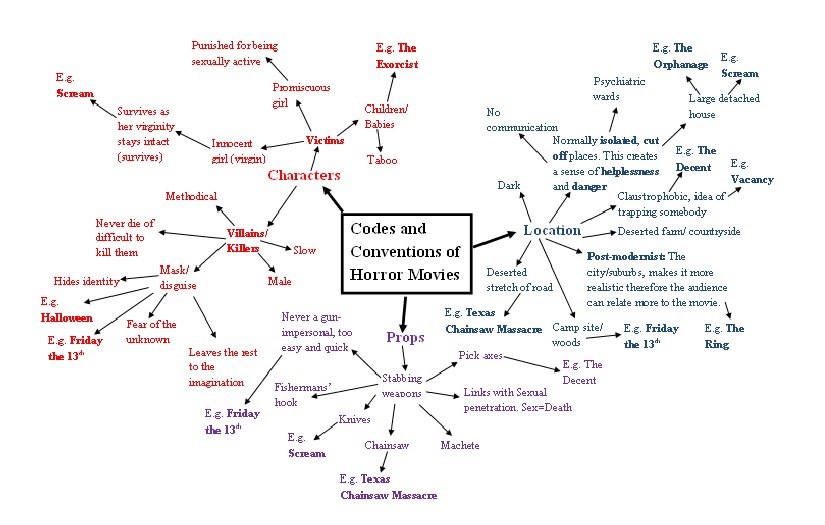
Stereotypical characters of Horror
Character who usually dies- In many horror movies you usually have an attractive female character or someone that dies in the woods or somewhere in the beginning of the horror movie
the unlikely hero- the character in the movie which makes the audience think hes a hero because of the skills they have but they always usually die doing something stupid
The protagonist- usually played by female character due to the fact that they are usually are intelligent and sensible in the films
The antagonist-usually one of the main characters which sometimes has a few helpers to help throughout the horror movie
Props used in Horror
Fake blood
Weapons which usually suggest a type of violence and horror to the crowd, such as axes, knives, chainsaws, and other weapons. When audiences see this it usually creates a sense of fear.
Masks which usually cover the main villains face, such as Friday The 13th: Jason
Bodies because usually you have many people that die in Horror films
Colors in Horror
Red-usually signifies blood, the devil, or threats
Black- Mystery, darkness, evil, fear, death. There is also something in film called the black sheep, someone who is neglected from society, used to show why the villain became how he did because of neglection
White- coldness, innocence, emptiness
Sounds of Horror
Non-diegetic sound- This type of sound is always used in the background of scenes in horror movies and is considered one of the most important areas of sound because this is what causes the most tension in the audience. There is usually a slow violin playing or other instruments that make the scenes seem cold, dark, feeling of being alone.
Synchronous sound- Sound that is usually placed in jump scares to frighten the audience. It is usually very loud and put in the most intensifying scene in horror movies. A perfect example of this is in the movie IT they are looking at a clip in a garage of Penny wise when out of nowhere he jumps out of the clip with a scary face and laughing and screaming at the kids when playing loud clown music.
Settings of Horror
The most common settings for horror films are places that are abandoned or isolated like the middle of the woods or a home that is located in the middle of nowhere. A perfect example of a horror setting is the Roanoke house in American Horror Story. It’s an isolated home located in the middle of the forest. These are usually creates tension and suspense in the audience because since it is so isolated something could happen out of nowhere with the villain.
Costumes used in Horror
costumes in horror films usually make the characters role recognizable to the audience. Antagonists are usually dark to fit in with the usual semantic field of mystery and the protagonists usually wear light colors to show a sense of hope to the audience. There are also some costumes that are very iconic such as the Freddy Cougar with his messed up face and his long sharp claws. When we see this costume outside of the movie we automatically think of this character and the film he was in.







 Rafael Benavente's Blog